A step-by-step guide to building D&D characters with AI
tap to enter
FORGE | Character Builder
tavern
Forge Your Character
Build a D&D 5e character in three steps.
This guide walks you through using a free AI assistant to build a character
that goes beyond stats. You'll end up with a full character file: mechanics,
backstory, voice, and visual direction. Almost everything you and the DM
need to bring your character to life.
Pick Your AI Assistant
Pick one. The prompts below will adjust to match. Open a new chat when you're ready.
ChatGPT
Free
Best for creative storytelling. Good at improvising backstory and personality. Widely used, easy interface.
You'll copy prompts from this page and paste them into your AI chat. Flip back and forth as you go.
Your Table's Rules
Set these to match your DM's rules. The prompts below update automatically.
3-2-1 system: Rare = 3, Uncommon = 2, Common = 1
Step 1
Build Your Character
This prompt covers concept, mechanics, and backstory in one flowing conversation.
Paste it into a new chat. Then just answer questions.
Paste into a new chat
ChatGPT
What to expect
The AI will ask you what kind of character you're imagining. Don't overthink it. "A sneaky rogue" or "someone who punches things" or "I have no idea" are all fine starting points. From there, it'll walk you through mechanics, backstory, personality, and more, one question at a time.
Pro tip
If you already have a character concept, dump everything you know upfront. If your DM gave you rules (starting level, allowed books, house rules), mention those early. The AI will adapt.
Heads up
AI assistants sometimes get specific rules wrong. If a feature or spell sounds too good, double-check it on 5e.tools or ask your DM.
Don't know D&D lore?
That's fine. Just describe the vibe ("dark and gritty" or "whimsical and weird") and the AI will handle the setting. Your DM can adapt it to their world.
Why "hooks for the DM" matter
Your DM builds the story around your characters. Named people, unresolved threads, and open questions in your backstory are what make the campaign personal. A character whose "whole family is dead" gives the DM nothing. A character who owes a debt to a merchant named Havel and hasn't spoken to their sister in six years? That's a story waiting to happen.
Step 2
Voice & Look
How does your character sound, move, and look?
This is what makes roleplaying feel natural at the table.
Paste when backstory is done
Based on the character we just built, generate all of this in one response. Don't ask me questions, just build it from what you know:
VOICE: How they talk (short or long sentences, verbal tics, what they say when nervous). 3 example lines I can use at the table. 3 signature one-liners for key moments (surviving danger, asked about their past, party is arguing). How they introduce themselves.
MANNERISMS: 4-5 physical habits tied to their backstory. What they do with their hands, how they enter a room, how they sit.
LOOK: Height, build, distinguishing features, what they're wearing and why. Scars or markings from the backstory.
SCENE: One image of this character. Where, what time of day, what they're doing, what the mood is, dominant colors.
Make everything specific to this character. Nothing generic. When you're done, tell me: "Voice and look are set. Go back to the guide and paste the Step 3 prompt."
What to expect
The AI will build a roleplay guide from your backstory. Read it carefully. If something doesn't feel right, say so. This is the section that makes the difference between "I play a rogue" and actually playing one.
Pro tip
The best mannerisms are small and specific. "He's tough" tells you nothing. "He eats slowly and finishes everything on the plate because he grew up hungry" tells you everything.
Step 3
The Export
The final prompt compiles everything into one clean character file.
Copy the output and send it to Travis.
Paste to generate your character file
Before you compile, double-check all mechanics against the latest official rules. Verify ability score math, AC calculations, class features at level 7, spell lists, and magic item effects. Search the web if you need to confirm anything. Fix any errors first.
Now compile everything we've discussed into a single, structured character file in markdown format. Use exactly this structure:
# [Character Name]
## Quick Reference
- **Race:** [race and variant/sourcebook]
- **Class:** [class (subclass)]
- **Level:** [level]
- **Alignment:** [alignment]
- **Background:** [background]
- **Gender:** [gender]
- **Party:** [party name if known]
- **DM:** [DM name if known]
- **Player:** [player name]
## Ability Scores
| STR | DEX | CON | INT | WIS | CHA |
|-----|-----|-----|-----|-----|-----|
| [score (mod)] for each |
## Combat Stats
- **AC:** [total] (breakdown of how it's calculated)
- **HP:** [total] (breakdown)
- **Speed:** [speed with any modifiers]
- [Any resource pools like Ki, Sorcery Points, Spell Slots, etc.]
- **Proficiency Bonus:** [bonus]
## Key Features
[Table with Feature | Detail columns for every important class/racial ability]
## Magic Items
[Table with Item | Rarity | Points | Attune | Effect if using point-buy system]
## Backstory
[The full backstory, organized into sections with headers for each major life phase]
## Personality
[Bullet list of core personality traits]
## What [Name] Knows
[Bullet list of what the character is aware of]
## What [Name] Doesn't Know
[Bullet list of secrets, hidden connections, unknown truths]
## DM Hooks
[List of 5-7 backstory elements the DM can use: named NPCs, unresolved threads, debts, enemies, places, secrets. Format each as: **Hook name** - one sentence description]
## Roleplay Guide
### Speech Patterns
[Bullet list with bold labels and examples]
### Physical Mannerisms
[Bullet list with bold labels and explanations]
### Key Lines
[Memorable one-liners with context for when to use them]
### How They Introduce Themselves
[Specific phrases for different situations]
### Situational Reactions
[Bold situation headers with paragraph descriptions]
## Visual Direction
### Appearance
[Physical description]
### Scene Description
[The "hero image" scene]
### Mood & Palette
[Visual atmosphere and color direction]
## Source Material
- Built with [AI assistant name], [current date]
- Campaign: [campaign name if known]
- Sourcebooks referenced: [list]
Make it thorough. Include everything we discussed. Don't summarize or skip sections. This is the final product.
Send It
Copy the character file from your AI chat and paste it here.
That's it. You're done.
Before you submit
Read the output carefully. Make sure the AI didn't invent details you didn't approve, especially in the backstory and personality sections. If something feels off, tell it to fix it. This is your character.
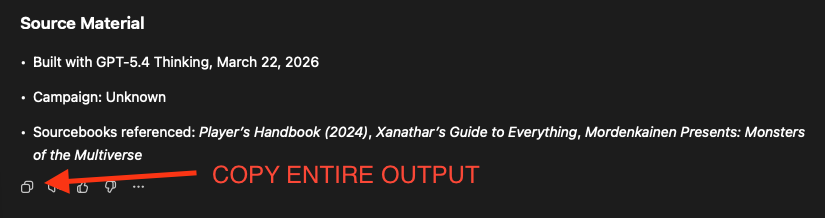
In ChatGPT, scroll to the end of the character file. Look for the icons below the response. The first icon (far left) copies everything. Tap it, then paste below.
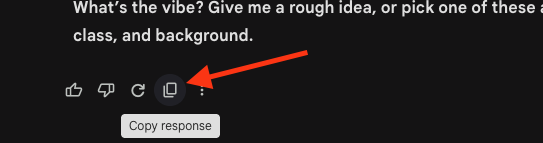
In Gemini, look for the clipboard icon below the response. That's "Copy response." Tap it, then paste below.
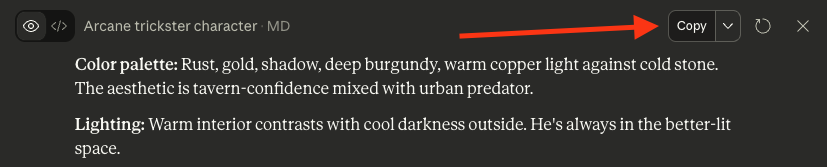
Claude opens your character file in a separate panel. Look for the Copy button in the top-right corner of that panel. Tap it, then paste below.